The Question
Of Identity


Needless to say, the question of a contemporary Indian
identity in design is a difficult one, since the context of Indian identity
itself is a deeply debated one today. Identity in any case, is complex and
often in flux – and regional and national affiliations may come at the cost of
each other.
Today, most people and governments in the world wish to
become more like the industrialised countries of Europe and America. National
identities all over the world are getting standardised to fit the image of a
‘global consumer’ with only minor variations. India is no exception. It is
commerce, not individual skill, which is now the creator of objects as well as
of identities, and financial value is the most coveted attribute. The
omnipresent market, in the form of corporations and large entities, shapes both
our choices as consumers and designers. It also shapes identities in more overt
ways. It re-makes national boundaries – witness the cleaving of the U.S.S.R.
and much of Europe through the force of capital and capitalism in the recent
past.
Colonialism, the most aggressive form of industrialism, has
done the same thing in the distant and not-so-distant past. There is, as we
know, a Punjab east and west of the Pakistan-India border; and people on both
sides of the Bangladesh-India boundary speak Bangla, wear similar sorts of
saris, and draw equal inspiration from the songs and compositions of
Rabindranath Tagore and Kazi Nazrul Islam. There are also vast numbers of
expatriate communities all over the world, who rarely renounce their original affiliations,
even if they reside in a different nation.
Regional identities, too, are not static. A geographical
part of Madhya Pradesh is now a separate state of Jharkhand. Many families in
Dharwar in Karnataka speak Marathi, the official language of Maharashtra. With
the rising number of inter-caste and inter-community marriages, parents in one
family may not only be from different regions of India but also often have
different languages as their mother-tongues. Such changes may allow us new and
dynamic ways of seeing ourselves and our contexts. But more worryingly, in many
areas, agendas set by national leaders seem to ignore or clash with regional
aspirations, leading to often violent confrontations with the idea of the
nation and the ideas of a people.[1]
In any case, the concept of the nation-state, as conventionally
understood, is something we have adopted – rather than adapted – from the western
world. The very word ‘nation’, is derived from Latin. It is defined in the 1959
edition of the Chamber’s Twentieth Century Dictionary, as ‘a body of people
marked off by common descent, language, culture, or historical tradition’.[2]
‘National’ is defined as: ‘belonging or peculiar to, characteristic of, or
controlled by a nation.’[3]
An edition of the 2003 Oxford Dictionary omits the mention of descent in its
definition of ‘nation’. It simplifies the meaning to ‘a large group of people
sharing the same culture, language or history, and inhabiting a particular
state or area’. Its definition of ‘national’, as ‘having to do with a nation;
owned, controlled or financially supported by the state, a citizen of a
particular country’,[4]
incorporates new meanings. Control, is now thus, specifically financial
control, and the idea of something ‘characteristic or peculiar to a nation’ is
no longer stated.
When the same western culture incorporates varying overtones
in its definitions of ‘nation’ over the span of merely half a century, it is
reasonable to assume that different cultures over different times must have
seen the idea of nation differently from the conventional modern notion. The conventional
definition of ‘Indian’ in English as: ‘belonging
to India (with various boundaries); a member of one of the races of India’, is
obviously limited. Did we, as a nation then only come into being when
the British decreed us one? What do the words ‘India’ and ‘Indian’ signify
beyond the current geographical and political meanings? What is our pre-modern
idea of a nation. How did we see ourselves, and how do we see ourselves? Who,
after all, are ‘we’? What are the lakshanas of being Indian?[5]
One of these lakshanas, certainly for a great part of our
history, appears to be a spiritual, ritual and practical link with both
immediate and larger backgrounds. It was very strong and real affiliations that
Indians, certainly till at least a generation ago, had with their context –
family, land, community, village, town and region. These affiliations can be
clearly witnessed in people who still have a strong relationship with the land
– adivasis, rural communities,
shepherds, small farmers. Land, signified and loved as earth and mother, is synonymous with Desh or country. This emotional attachment to the land, whether or
not you are a land owner, comes with a deep sense of responsibility towards it.
My maid and cook, for instance, speak of going to their desh, not their village
or town. Even today, the Beghas, an adivasi community in Chattisgarh, firmly
believe that the earth is their mother. They practice a system of sowing which
does not use the plough, which they say rents the breast of the earth. The
Begha system of sowing nourishes them as well as their land; it is a practice
that helps in consolidating the dry slopes of Central India, while conventional
agriculture ways weaken and dislodge this landscape.[6]
But this emotional attachment, though it may in its extreme forms result in
parochial attitudes, does not imply a conflict with other lands. This is
different from the conventional western notion of asserting supremacy of the
nation on the basis of religion, State, or region, as demonstrated most
tellingly in the case of Nazi Germany or in the colonial experiments of Europe
and America.
This was because land, though an indissoluble part of an
individual’s identity and security, was, till the British colonial policy
disrupted it, a community asset in India. An extensive survey and study of
British records from the time that they moved into India, has been done by the
Gandhian historian, Dharampal. These records clearly show the presence of
decentralised yet firmly rooted and connected practices that enabled a cohesive
functioning of individuals with communities, habitats and regions in India. As Dharampal
explains, ‘the community (geographical, or based on occupation, or kinship)
seemed to have been from very ancient times the primary unit of organisation in
India…in most areas the village community as a whole had the final say not only
in matters which concerned the village as a whole but also with regard to any
transfers, or alienation of village land or other sources from one party to
another. In samudayam villages of
course and perhaps similarly in the bhai-chara
villages, the total land and other resources completely vested in the community
while simultaneously the individual family had a hereditary claim on its own
share of such resource.’[7]
This was a practical application of the conception of space
and time in most systems of Indian philosophy. The idea of the vastness of
space and time, and how the lifetimes of human beings count but little in this
vastness; yet the belief that they, like everything else in this universe, are
an important part of a larger fathomless whole, informed each aspect of Indian
thought and creativity. Habib Tanvir found this idea of space and time
informing not just the ancient Sanskrit works of drama but also in living
traditions of regional-theatre. He explains it as: ‘[w]hat the villagers do by
way of simplicity of staging, the imaginative use of space with regard to
make-believe, and the manner in which they deal with time…’. He drew on this
realization of time and space in his own productions and ‘…came right back to
‘Indianness’…to our Sanskrit tradition and folk traditions. Blending folk with
the classical, realising there are no barriers.’[8]
Both the arts and sciences in the Indian tradition affirm a view of there being ‘no barriers’ in the cosmos, conceived with the aid of a vocabulary and an organisation of numbers and entities which moves effortlessly between the infinitesimal and the infinite. The Sanskrit shloka that forms the opening invocation in the Isa Upanishad is routinely chanted in many Hindu households even today. It sums up this world view,[9] which is very different from the current dominant conceptions in most parts of the world of humans dominating nature, or being mere instruments subject to an overwhelming God.
Both the arts and sciences in the Indian tradition affirm a view of there being ‘no barriers’ in the cosmos, conceived with the aid of a vocabulary and an organisation of numbers and entities which moves effortlessly between the infinitesimal and the infinite. The Sanskrit shloka that forms the opening invocation in the Isa Upanishad is routinely chanted in many Hindu households even today. It sums up this world view,[9] which is very different from the current dominant conceptions in most parts of the world of humans dominating nature, or being mere instruments subject to an overwhelming God.
Purnamadah purnamidam
Purnartha
Purnamudhachyate
Purnasya Purnamadya
Purnameva Vashishyathe
Secondly, unlike much of dominant Western thought which sees
humankind marching forwards on a linear road of progress, Indian philosophies
explain existence as a cyclical journey, which in each cycle is actually a
process of regression. So, many Indians even today, despite being brought up on
a formal education which promotes the Darwinian notion of evolution, fall back
on the phrase ‘Yeh Kalyuga hai’ to explain
away the ills of today’s age. The characteristics of Kalyuga, the last in a
cycle of four yugas, each falling further from the ideal of truth and equality,
and the idea of space and time that it is part of, continue to be part of the
Indian imagination – seen and heard in our films, songs, or proverbs.
Within the nation, the idea of being part of the same
nationality is implicit, with a few exceptions. It is when interacting with an
international audience, that the explicit signs of a nation are deliberately
brought forward. The most grandiose notions of homeland and nation come to mind
when one is banished or is away from the homeland, or when one is presenting it
to other homes, other lands. The Island
of Sheep, was first published by Hodder and Stoughton in 1936. Written by
John Buchan, who went on to become the 35th Governor-General of
Canada, and is feted as ‘one of Britain’s finest writers of suspense stories,’
it is a tale of breathless adventure. It, also, as a sidelight, offers views of
glorified ‘national’ attributes. Its heroes, indubitably British, but much
travelled all over the world in an era when Britain was a colonial power, seek
to cast the world in a version of values that seem special to their home and
nation. Thus, one of them, back in England, ‘as he sniffed the scents coming up
from the woods and the ploughlands, seemed to feel the magic of the place.
“Pretty good’, he said. “England is the only real comfortable spot on earth –
the only place where man can be utterly at home”.[10]
Note the sweeping generalisation about the idea of home, and how this idea of
home must be true for everyone; for ‘man’, not just for an Englishman.
In the western world, as we know, the idea of the supremacy
of man over nature especially after Renaissance, later went on to denote the
supremacy of a certain race and religion of man over not just nature but the entire
world. The role of spirituality also changed and diminished. Travels
in The Mogul Empire 1656-1668 was written by the Frenchman
and traveller, Francois Bernier, several centuries before the fictional
characters of The Island of Sheep. This was
a time when religion was a great driving force. Bernier was held to be more
objective than many other European travellers to India, and his book was lauded
by its 19th century British translator for its ‘very remarkable accuracy’.
A conversation recorded in the book, reveals the differences in the lakshanas of the Indian and the western idea of the world and the self, even as late as the 17th century. Some learned Pandits gave this answer in response to Bernier’s question about their religion. “We pretend not,” they replied, “that our law is of universal application. God intended it only for us, and this is the reason we cannot receive a foreigner into our religion. We do not even say that yours is a false religion: it may be adapted to your wants and circumstances, God having, no doubt, appointed many different ways of going to heaven.” And this is Bernier’s comment on this answer: “I found it impossible to convince them that the Christian faith was designed for the whole earth, and theirs was mere fable and gross fabrication.”[11]
A conversation recorded in the book, reveals the differences in the lakshanas of the Indian and the western idea of the world and the self, even as late as the 17th century. Some learned Pandits gave this answer in response to Bernier’s question about their religion. “We pretend not,” they replied, “that our law is of universal application. God intended it only for us, and this is the reason we cannot receive a foreigner into our religion. We do not even say that yours is a false religion: it may be adapted to your wants and circumstances, God having, no doubt, appointed many different ways of going to heaven.” And this is Bernier’s comment on this answer: “I found it impossible to convince them that the Christian faith was designed for the whole earth, and theirs was mere fable and gross fabrication.”[11]
In the Indian philosophy of Vasudeva kutumbhaya, there existed a system of interdependence
between people, objects and their contexts. This system drew from an
intellectual and a spiritual framework, propelled by a philosophy that
recognised dominant as well as fringe beliefs. In practical terms, this system
of interdependence was created and continued through regional, professional or
community-based identities. These identities were not static, as evident in the
internal reorganisations that occurred through the efforts of individuals or
groups who questioned and evolved or changed these systems repeatedly. Objective
disagreements and debates were a key component of Hindu, Jain, Buddhist, Sufi
practical and theoretical philosophy. These debates proceeded, not by rejecting
different religious systems – as evidenced in the Brahmins’ tempered rejoinder
to Bernier’s question – but by acquiring a systematic knowledge and exposition
of their features, before refuting or accepting them. So, for instance,
Hinduism in its later years draws from Buddhism, Jainism, and even Islam and
Christianity; Buddhism, Jainism, and Sikhism arise out of an attempt to distil,
adapt, or evolve a reformed idea of Hinduism and other religions and beliefs.
As the great poet and philosopher Rabindranath Tagore explained,
‘unlike in Europe, the State has never been in India a central thing in the
life of the nation. While European civilization assigned a central position to
the State, Indian civilization from ancient times put in that place society
guided by dharma as it was conceived
by the people.’[12] Further,
all these people, objects and contexts practising different variations of
different religions in different regions, were tied into a larger whole through
a vision of sacred geography, which spanned great parts of the sub-continent.
So, not only are streams, springs, mountains, rocks and trees sacred to a
region and inviolate, but also pilgrims from other parts journey to see and
worship these. Even today, people from the deepest south, east and west travel
to the Himalayas in the north, to visit the places extolled in hymns and
history[13];
place-names and even forms all over the sub-continent are made in memory of the
regions that people have moved from;[14]
temples in the mountains of North India transport you to those in East India.
Clear instances of the intermingling of regions are evident
in most of the Brahmin families from the Central Himalayas, who align themselves
with the Pahars, the mountains, and
often introduce themselves simply as Paharis. This is their first identity
today, reflected in both language and customs. Though they settled here at
least three to four hundred years ago, they retain the memory of their original
region as well. My grandfather, Pandit Daya Krishna Joshi, told his sons that
they came to the Kumaon mountains from Dharwad on the Maharashtra-Karnataka
border. A sister-in-law’s family who moved from Karnataka, has chosen to
remember their original region more directly. They speak Kumaoni amongst
themselves, but their family title is Karnatak. Her grandfather was named
Badri, after one of the foremost deities of the mountains. His name, Badri Dutt
Karnatak, thus carries his present as well as original regional identity. So,
the first allegiance seems to be that of the region, not caste, not profession.
And the final allegiance was not just to the region or the
nation, but the world and your soul. The Mahabharata says: ‘Give up the
individual for the family, the family for the habitat, the habitat for the
land. But for the Aatman, give up the
whole land’.[15] Such
responsibilities towards region and land, and to a lesser extent to the
‘Aatman’ are still there, but in a far more diluted fashion. One of the reasons
is that language, which is one of the most visible variants of regional
identity as well as the most potent medium for the expression of individual
identity, is now far more standardised.
Part of this is an imposed standardisation. So, one version of Hindi is promoted as the ‘correct national language’. Regional variants such as Maithili, Bhojpuri, Awadhi, and so on, are not considered as important. In my own family, none of my cousins can speak in Kumaoni and Garhwali; we converse entirely in either English or Hindi. The second reason is that many of us now grow up in urban situations divested of regional contexts. Even for those who do grow up in small towns or cities, the aspiration (which quickly translates into reality) is to move out – to bigger cities in the country or to work-places outside the country. The rich and the middle-class, who become the standard model for many, including the poor and the oppressed, mimic a stereotypical image of the Western world. In a recently published interview in a national newspaper, Chandra Bhan Prasad, introduced as ‘a traveller, an analyst, a writer, a scholar,’ had this to say in response to a question about whether he saw changes in the lives of Dalits and tribals.
Part of this is an imposed standardisation. So, one version of Hindi is promoted as the ‘correct national language’. Regional variants such as Maithili, Bhojpuri, Awadhi, and so on, are not considered as important. In my own family, none of my cousins can speak in Kumaoni and Garhwali; we converse entirely in either English or Hindi. The second reason is that many of us now grow up in urban situations divested of regional contexts. Even for those who do grow up in small towns or cities, the aspiration (which quickly translates into reality) is to move out – to bigger cities in the country or to work-places outside the country. The rich and the middle-class, who become the standard model for many, including the poor and the oppressed, mimic a stereotypical image of the Western world. In a recently published interview in a national newspaper, Chandra Bhan Prasad, introduced as ‘a traveller, an analyst, a writer, a scholar,’ had this to say in response to a question about whether he saw changes in the lives of Dalits and tribals.
Yes, the biggest change that has occurred and which I thought would never
happen in this country—that food sources have become common for Dalits and
upper castes. Earlier, Dalits mainly ate millets...what is called coarse grain.
That was a low social marker—this is Dalit food or cattle feed. Now Dalits and
upper castes and OBCs have common sources of food—wheat and rice. And jeans and
T-shirts have become new weapons of emancipation. I see in villages Dalit youth
sporting jeans and T-shirts. Something is happening in the countryside.
Dressing well, eating well. They are also migrating from the countryside to cities
like Mumbai and Aurangabad and Ahmedabad and elsewhere.’ [16]
It is interesting to read this,
especially in the light of increasing recognition of the rich food value of
millets, which are now being embraced by the health-conscious in India and the
rest of the world, and which have now become as, if not more expensive than,
wheat and rice. It is also worthwhile to recollect that ‘khichri’, a food item reserved today for illness or banter, was a favourite
of the Mughal Emperor Shah Jahan, arguably the richest ruler of the medieval
world, as of his father, Jahangir. In fact, records show that three hundred
years ago, the food that the rich and the poor ate was not substantially
different, and included such healthy items as millets of various kinds.
Nationhood today, like the food we eat or the language we
speak or the architecture and attire that we promote, is paradoxically an
exclusivist choice that allows dominant versions to standardise regional richness.
Yet both philosophical texts as well as childrens’ tales still transmit our
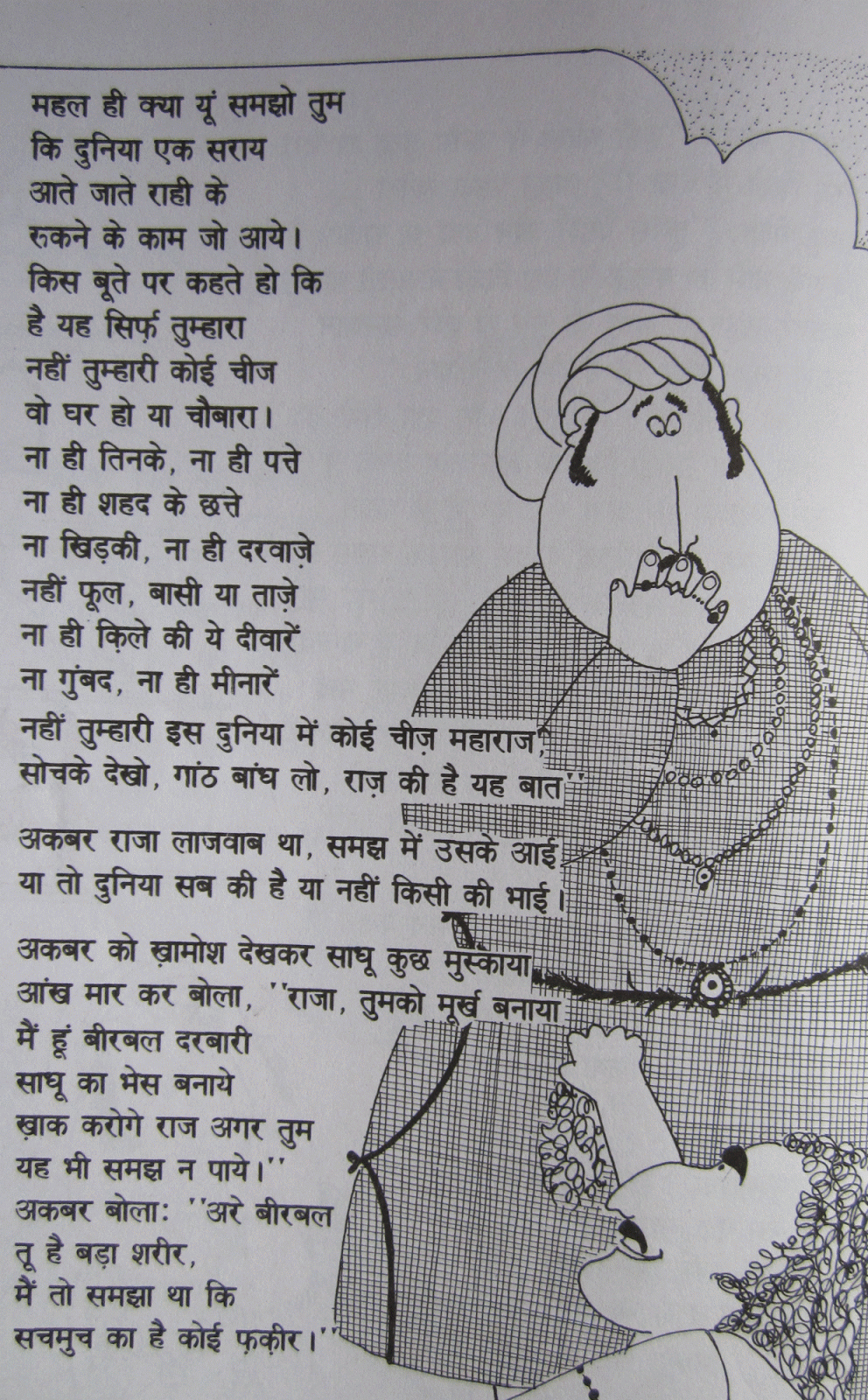
historical culture of amicable differences. Duniya sabki is a book of poems written for children, by the
activist, writer and stage-actor, Safdar Hashmi (April 12, 1954 – January 2, 1989). Its title poem, Duniya
sabki, in the Indian tradition of a dialogue between Emperor Akbar and his
wise courtier, Raja Birbal, demonstrates to the reader as to the Emperor, who
has grown arrogant with power and believes everything belongs to him, ‘that either
the world is everybody’s or nobody’s at all’.[17]

This view of the world, allowed divergent and diverse expression of
ideas, but is no longer officially encouraged – witness our national school curriculum.
Political lingo and objectives set out the attributes of an ideal homogenized
Indian. Generally, region and nation in actual terms today is seen to be an
either/or situation. To be a true national, you must not display too many
regional affiliations or associations. Harmony, it is assumed, can only be
achieved through similarity. We don’t really buy the idea of unity in
diversity; we simply tout it as a convenient line.
In such a time, most of us, designers or otherwise, are not clear
of what our regional and national
identify comprises of, or what role design or designers can have in formulating
or even an expressing ‘Indian’ identity. Can we be uniquely Indian with
distinguishing regional attributes, in a time when global influences are so
frenetic? If yes, would not this identity of Indian-ness in design be something
that designers today can positively capitalize on—to project
the image of being Indian, to continue certain characteristics which can be an
asset for India and for design? If not, then is it not time that we look within
to seek out such qualities that help Indian Design to stand out in an
increasingly standardized and homogenized world?
To explore this further, read Part III - Moving Beyond ‘The Market of Things’ To ‘The Maker of Things’
[1]
The increasing Maoist and
people’s movements against the Indian State in many rural and tribal areas, are
a manifestation of this conflict between regional and national aspirations.
[2] Chamber’s Twentieth Century Dictionary, Edited by
William Geddie, first published 1901,
revised new edition 1959, W. and R. Chambers, Edinburgh and London
[3]
Ibid. p. 712; Further we find the definitions of Descent: ‘transmission by
succession, derivation from an ancestor’, p. 283; and Culture: ‘a type of
civilisation’, p. 257
[4]
Oxford Dictionary and Thesaurus,
Indian edition 2003, OUP, Delhi, Catherine Soanes, Alan Spooner, Sara Hawker.
Note also definitions of ‘Culture’: ‘the arts, customs, and institutions of a
nation, people or group’; and ‘descent’: ‘a person’s origin or nationality’.
[5]
A thought-provoking exploration of ‘Is there an Indian Way of Thinking’, can be found in The Collected Essays of A. K. Ramanujan, edited by Vinay Dharwadker, OUP,
2012
[7] Dharampal, p.35, Chapter 3: ‘Erosion
of Norms and Dignity in Modern India’, Rediscovering
India, SIDH Mussoorie 2003. See also pp. 12-13; and p. 79-84, Annexure C,
(‘Gentoo Internal Government on the coast of Chormomandel’, Alexander
Dalrymple, London, 1783); and Annexure D: (‘Land Rights and Village
Organisation’, S. Lushington, Collector Of Tinnevelly and Ramnad Pollams, 1800)
[8]
p. 23, ‘My Milestones in Theatre, Habib Tanvir in Conversation’, Charandas Chor, Seagull Books 2004,
Kolkata.
[9]
"From the whole the whole, from the complete arises the
complete. Deducting the whole from the whole, the whole alone remains.", http://en.wikipedia.org/wiki/Isha_Upanishad;
[12] The
Mahatma and The Poet, Letters and Debates between Gandhi and Tagore
1915-1941, Compiled and Edited by Sabysachi Bhattacharya, National Book Trust
India, First Edition 1997, Fourth Reprint 2008, Saka 1929, p. 25, Introduction.
[13]
In the 1960s, when Dharampal was travelling in a 3rd Class coach of
a day-train from Gwalior to Delhi, he met a group of about twelve villagers
carrying their cooking vessels and their provisions. These people, about four
of whom were women, were from two different villages near Luckhnow, and were on
a pilgrimage. They had journeyed over a period of three months, among other
places, to Rameshwaram, in the very south of India and were now on their way to
Hardwar, where the Ganga descends from the mountains, before returning home.
Dharampal, in a conversation that lasted the 6-7 hours of the train travel,
learnt from them that though they had passed through Madras, Bombay, and other
important destinations of ‘modern’ India, they had not stopped to see anything
there. He also learnt that they were from different jatis, but on a pilgrimage there are no jati or caste differences.
Claude Alvares, Preface: ‘Making History’, Indian
Science and Technology in the Eighteenth Century, pp. v–vi, in Dharampal,
SIDH Mussoorie and OIP Goa, 2007
[15]
Bharat Gupt, India:
A Cultural Decline or Revival, Preface, p. xiv, D. K. Printworld (P)
Ltd, New Delhi, 2008
[16]
Walk the Talk,
The Indian Express, Shekhar
Gupta in conversation with Milind Kamble, founder of the Dalit Indian Chamber
of Commerce and Industry (DICCI), and Chandra Bhan Prasad, his mentor,
http://www.indianexpress.com/news/capitalism-is-changing-caste-much-faster-than-any-human-being.-dalits-should-look-at-capitalism-as-a-crusader-against-caste/1127570/7
[17]
Safdar Hashmi, ‘Duniya Sabki’,
‘…Samajh mein uske aiee, Yaa to dunia
sabki hai, yaa nahin kisi ki bhai’, 2006 Edition, SAHMAT, New Delhi
Images © Anisha Shekhar Mukherji; Text © Anisha Shekhar Mukherji


